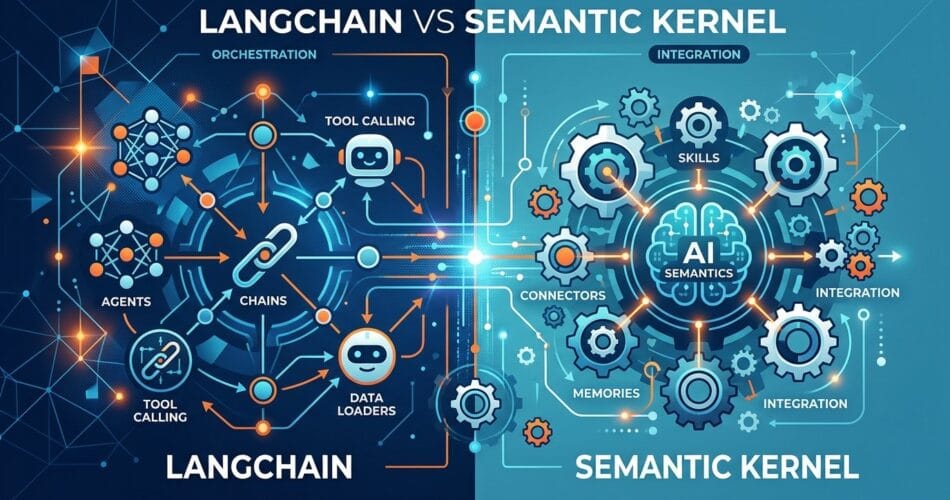
When building LLM applications and autonomous AI agents in 2026, developers generally face a crossroads: do you adopt the immensely popular, open-source LangChain, or do you integrate Microsoft’s enterprise-ready Semantic Kernel? Both orchestration frameworks help you tie language models, prompts, and native code together, but they approach the problem from fundamentally different philosophies. If you are reading this, you are probably trying to figure out which one is right for your tech stack.
In this comprehensive comparison, we will break down the strengths, weaknesses, code structures, and ideal use cases for both LangChain and Semantic Kernel. We will also dive into advanced concepts like state management and enterprise deployment to help you choose the right tool for your next multi-agent project.
LangChain: The Swiss Army Knife of AI
LangChain took the AI world by storm a few years ago. It is designed around modular components: LLMs, prompt templates, indexes, memory, and agents. Its primary language is Python, though the JavaScript/TypeScript ecosystem is also heavily supported. The core philosophy of LangChain is flexibility and speed.
Strengths of LangChain
- Massive Ecosystem: If there is a new vector database, API, or foundation model released today, LangChain will likely have a community-supported integration for it tomorrow.
- LangGraph Integration: The shift from linear, state-less chains to cyclical, graph-based agents (LangGraph) allows developers to build highly complex, multi-agent workflows with persistent state.
- Community Support: Finding tutorials, StackOverflow answers, and pre-built templates for LangChain is incredibly easy because of its massive adoption rate.
- Prototyping Speed: You can spin up a RAG pipeline in just five lines of code.
Semantic Kernel: The Enterprise Architecture
Semantic Kernel is Microsoft’s answer to AI orchestration. It is built natively for C#, Java, and Python, making it deeply appealing to traditional enterprise developers using the .NET stack. Instead of treating the LLM as the center of the universe, Semantic Kernel treats AI models simply as another computation engine that can be called by native code.
Strengths of Semantic Kernel
- Native C# and .NET Support: This is the biggest differentiator. For enterprises already heavily invested in Microsoft technologies, Semantic Kernel feels like native code rather than a bolted-on script.
- Planners over Chains: Instead of manually hardcoding the sequence of operations, Semantic Kernel relies heavily on ‘Planners’ that automatically deduce the steps required to fulfill a user’s intent.
- Enterprise Safety: Built by Microsoft, it integrates flawlessly with Azure OpenAI, Azure Active Directory, and enterprise governance frameworks from day one.
- Semantic Functions: It enforces a clean separation between your semantic functions (prompts) and native functions (C# methods).
Advanced Concepts: Tools vs Plugins
Both frameworks allow your LLM to interact with the outside world, but they use different terminology and paradigms.
In LangChain, you create Tools. A Tool is simply a Python function decorated with a description. The LLM uses function calling to pass arguments to this tool. Because LangChain is dynamic, you can pass arrays of tools to an agent on the fly, allowing the agent to decide which one to use based on the conversational context.
In Semantic Kernel, you build Plugins. Plugins are highly structured. They are essentially collections of native code functions (like a database query) or semantic functions (like summarizing text). The strict typing of C# means that Plugins are inherently more robust against hallucinated arguments from the LLM, making them safer for enterprise data manipulation.
Code Comparison: The Basics
Let’s look at a simple semantic function execution to see the syntactical differences.
from langchain.prompts import PromptTemplate
from langchain_openai import ChatOpenAI

llm = ChatOpenAI(model="gpt-4o")
prompt = PromptTemplate.from_template("Summarize this text: {text}")

chain = prompt | llm
print(chain.invoke({"text": "Long article here..."}))
using Microsoft.SemanticKernel;
var builder = Kernel.CreateBuilder();
builder.AddAzureOpenAIChatCompletion("deployment-name", "endpoint", "api-key");
var kernel = builder.Build();
var summarizeFunction = kernel.CreateFunctionFromPrompt("Summarize this text: {{$text}}");
var result = await kernel.InvokeAsync(summarizeFunction, new() { ["text"] = "Long article here..." });
Console.WriteLine(result);Which Should You Choose?
The decision ultimately comes down to your existing tech stack, your team’s expertise, and your engineering culture.
- Choose LangChain if you have a Python-first team, need to integrate with dozens of different third-party APIs rapidly, and want to leverage the massive open-source community for pre-built agents.
- Choose Semantic Kernel if you are an enterprise C#/.NET shop, prioritize strict type safety and architectural rigor, and deploy heavily within the Microsoft Azure ecosystem.
If you end up leaning toward the Microsoft ecosystem, I highly recommend checking out my complete guide on Understanding Azure AI Agents to see how Semantic Kernel fits into the broader Azure cloud architecture.