
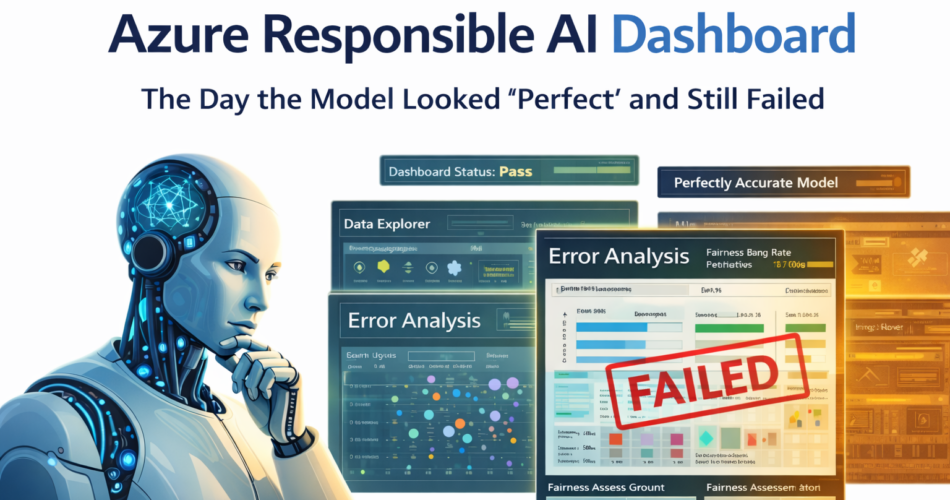
The Dashboard Was Green. The Problem Wasn’t.
The model passed every metric.
Accuracy was high. Precision looked solid. Latency stayed well within limits.
The deployment dashboard was glowing green.
A week later, a complaint landed in my inbox:
“Why was my application rejected when someone with the same profile was approved?”
I pulled the logs.
I checked feature values.
I reran predictions.
Nothing was technically wrong.
That was the problem.
This was the moment when the Azure Responsible AI Dashboard stopped feeling optional and became something I won’t ship without.
Why Traditional ML Metrics Aren’t Enough
Most machine learning workflows stop at performance metrics:
- Accuracy
- AUC
- Loss curves
- Inference time
Those numbers tell you how well a model predicts in aggregate.
They don’t tell you:
- Who the model fails on
- Why it fails
- Whether those failures cluster around certain groups
- Whether the behavior is acceptable in the real world
In systems that affect people, correctness alone is not safety.
The Azure Responsible AI Dashboard exists to surface the blind spots that averages hide.
What the Azure Responsible AI Dashboard Actually Is
The Azure Responsible AI Dashboard is a unified evaluation experience inside Azure Machine Learning designed to help teams:
- Understand why a model makes specific decisions
- Detect uneven performance across groups
- Analyze systematic failure modes
- Stress-test reliability and robustness
- Make accountability auditable
It’s not a single visualization.
It’s a set of analytical lenses applied to a trained model.
If performance metrics answer “Does it work?”,
the Responsible AI Dashboard asks “Is it safe to rely on?”
The Azure Responsible AI principles are what define what should be evaluated, and the dashboard is where those principles become measurable
The First Time I Used It (And Felt Uncomfortable)
I opened the dashboard expecting confirmation.
Instead, I found discomfort.
A Data Explorer slice showed error rates consistently higher for one subgroup.
Not enough to fail global metrics.
Not dramatic enough to trigger alerts.
But persistent.
The model wasn’t obviously biased.
It was quietly uneven.
That’s the kind of issue that never shows up in dashboards focused on averages—and the kind that causes real harm once deployed at scale.
What’s Inside the Azure Responsible AI Dashboard
Microsoft documents each of these analyses in detail in the official Azure Responsible AI Dashboard documentation.
Each component of the dashboard answers a different kind of risk question.
1. Model Overview – What Did We Actually Train?
This section captures:
- Model type and version
- Training and evaluation datasets
- Feature list
- Target variable
- Baseline performance metrics
It sounds basic, but it’s critical.
Six months later, when someone asks:
“Why did the model behave like this?”
You don’t want to answer:
“I think we trained it on… last year’s data? Maybe?”
You want traceability, not guesswork.
2. Data Explorer – Who Is the Model Failing?
Data Explorer lets you slice performance by:
- Demographic attributes
- Feature ranges
- Custom cohorts
- Prediction outcomes
This is where teams discover things like:
- False negatives clustering for one group
- Higher rejection rates tied to proxy variables
- Edge cases the training data barely covered
Bias rarely looks malicious.
It looks statistical.
This tool makes those patterns visible.
3. Model Interpretability – Why Did It Decide That?
Interpretability tools (such as SHAP-based explanations) show:
- Which features influenced predictions
- How strongly each feature contributed
- Whether the model relies on proxies instead of intent
This matters for accountability.
If your explanation is:
“The model made the decision,”
that isn’t an explanation—it’s an abdication.
The dashboard helps produce human-understandable reasoning, not just feature weights.
4. Error Analysis – Where Does the Model Break?
Error Analysis goes beyond accuracy scores.
It helps you:
- Cluster incorrect predictions
- Build decision trees over failures
- Compare correct vs incorrect cases
This answers questions like:
- Are errors random or systematic?
- Do failures occur under specific conditions?
- Are we missing entire classes of data?
Many teams discover the same uncomfortable truth here:
“We don’t actually have data for this scenario.”
5. Fairness Assessment – Is the Model Unequally Wrong?
Fairness metrics compare outcomes across groups using measures like:
- False positive rate
- False negative rate
- Selection rate
This matters because harm is not symmetric.
A false positive in spam detection is annoying.
A false positive in loan approval can change someone’s life.
The dashboard doesn’t declare what’s ethical.
It shows where trade-offs exist.
You still decide—but now you decide with evidence.
6. Counterfactual Analysis – What Would Have Changed the Outcome?
Counterfactual analysis answers a simple but powerful question:
“What is the smallest change that would flip this decision?”
For example:
- Slightly higher income
- One fewer missed payment
- Different employment duration
This tool is most valuable when:
- Decisions affect individuals directly
- Stakeholders demand explanations
- You need to test whether boundaries are brittle
If tiny, irrelevant changes flip outcomes, the model may be fragile—or learning shortcuts.
Counterfactuals expose that fragility.
How the Dashboard Changes Team Conversations
Before:
“The model meets accuracy requirements.”
After:
“The model meets accuracy requirements, but fails more often for this subgroup, relies heavily on this proxy feature, and behaves unpredictably in these scenarios.”
That’s a different conversation.
The Azure Responsible AI Dashboard doesn’t slow teams down.
It prevents false confidence.
How to Enable the Azure Responsible AI Dashboard
This isn’t theoretical.
Inside Azure Machine Learning, the workflow looks like this:
- Train and register a model
- Create a Responsible AI Dashboard job
- Provide:
- Model
- Training data
- Test data
- Sensitive features (if applicable)
- Review results in Azure ML Studio
One important detail:
You must explicitly decide which features are sensitive.
The dashboard can’t infer intent.
That decision alone forces clearer thinking about risk.
What the Dashboard Does—and Doesn’t—Do
The Azure Responsible AI Dashboard doesn’t replace human judgment.
It won’t:
- Decide ethics for you
- Automatically fix bias
- Guarantee regulatory compliance
- Eliminate the need for review
What it does do is make risks visible, trade-offs explicit, and decisions defensible.
Responsible AI isn’t about automation.
It’s about augmented judgment.
Why This Matters More Than Regulation
Regulations like GDPR (enforced since 2018) and the EU AI Act (approved in 2024, now being implemented through 2027) require:
- Explainability
- Risk assessment
- Human oversight
The dashboard didn’t appear because of regulation—but regulation makes ignoring these issues costly.
The deeper truth is simpler:
If you can’t explain your model,
you can’t defend it.
If you can’t defend it,
you shouldn’t deploy it.
When Teams Push Back
I’ve heard the objections.
“This slows us down.”
It slows deployment slightly.
It prevents months of cleanup later.
“It’s just an internal tool.”
Internal tools still affect people.
They just fail quietly.
“Our model isn’t high-risk.”
Neither was ours—until it was.
The Quiet Failure Mode
The most dangerous AI failures don’t crash systems.
They:
- Pass metrics
- Scale smoothly
- Look reasonable
- Harm selectively
The Azure Responsible AI Dashboard exists for that failure mode.
Not dramatic.
Not obvious.
Just wrong enough to matter.
What Changed After We Adopted It
We didn’t stop shipping models.
We stopped shipping unexamined ones.
We:
- Asked better questions earlier
- Documented decisions
- Flagged risks before deployment
- Built trust with stakeholders
The model didn’t become weaker.
It became safer—and often more accurate, because we fixed blind spots we didn’t know existed.
Final Thoughts
The Azure Responsible AI Dashboard isn’t about ethics theater.
It’s about engineering maturity.
At scale, AI doesn’t just compute.
It judges.
Judgment without visibility is a liability.
The dashboard doesn’t make your model moral.
It makes your decisions defensible.
So when someone asks:
“Why did the system decide this?”
You finally have a real answer.