
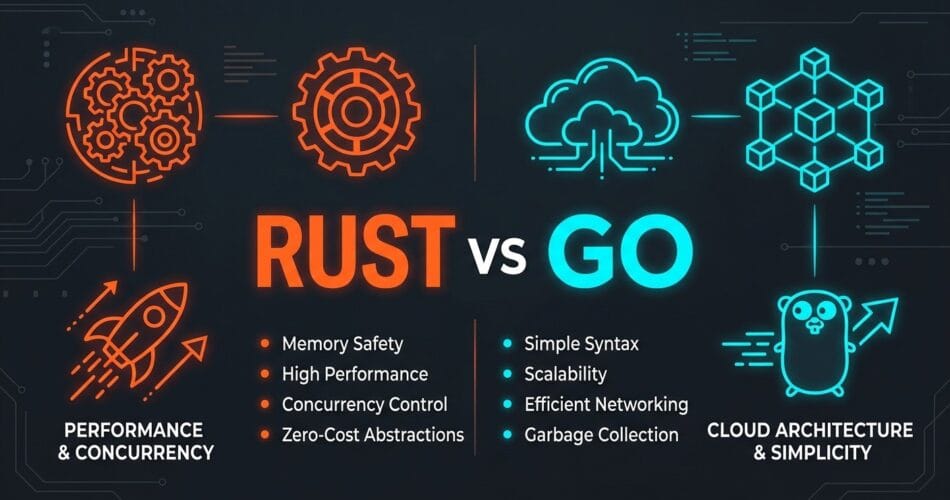
When it comes to building modern, high-performance backend systems, the debate almost always boils down to two languages: Rust and Go. By 2026, both languages have matured significantly, cementing their places in the enterprise stack. However, they solve the problem of systems programming in fundamentally different ways. After deploying production services in both, I want to break down exactly when you should choose the borrow checker over the garbage collector.
Go: The King of Concurrency and Simplicity
Go (or Golang) was designed at Google to solve a very specific problem: managing massive, networked codebases with large teams of engineers of varying experience levels. Its philosophy is rooted in simplicity and readability.
Why Choose Go?
- Development Speed: Go has a notoriously shallow learning curve. A developer can become productive in Go within a week.
- Goroutines: Concurrency in Go is a first-class citizen. Goroutines and channels make writing highly concurrent network services (like API gateways or microservices) trivial compared to thread management in other languages.
- Compilation Speed: Go compiles incredibly fast, which keeps the feedback loop tight during development.
package main

import (
    "fmt"
    "time"
)

func worker(id int, jobs <-chan int, results chan<- int) {
    for j := range jobs {
        fmt.Println("worker", id, "started  job", j)
        time.Sleep(time.Second)
        fmt.Println("worker", id, "finished job", j)
        results <- j * 2
    }
}Rust: The Champion of Safety and Control
Rust, born out of Mozilla, was designed to provide the performance of C++ while guaranteeing memory safety. It achieves this without a garbage collector, relying instead on a unique system of ownership and borrowing.
Why Choose Rust?
- Memory Safety Without GC: The borrow checker ensures that data races and null pointer dereferences are caught at compile time. This leads to incredibly stable production deployments.
- Predictable Performance: Without a garbage collector pausing execution, Rust provides deterministic performance, making it ideal for systems where latency must be strictly bounded.
- Fearless Concurrency: If your Rust code compiles, it is almost certainly free of data races.
use std::thread;
use std::sync::mpsc;

fn main() {
    let (tx, rx) = mpsc::channel();

    thread::spawn(move || {
        let val = String::from("hello");
        tx.send(val).unwrap();
        // println!("val is {}", val); // This would cause a compile error!
    });

    let received = rx.recv().unwrap();
    println!("Got: {}", received);
}Direct Comparison: Making the Call
So, which one should you choose for your next project?
Conclusion
In 2026, the industry has largely settled into a complementary pattern: Go for the network layer, and Rust for the compute-intensive core. Many large-scale systems (including orchestration frameworks like Kubernetes and modern databases) utilize both languages where they shine best. Don’t fall into the trap of language tribalism-pick the tool that aligns with your specific constraints around latency, team velocity, and safety.