
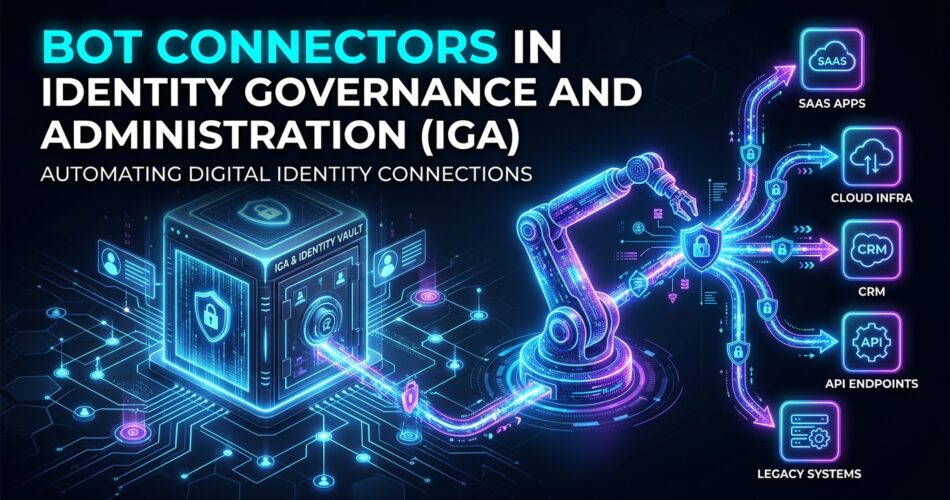
Identity Governance and Administration (IGA) platforms are heralded as the cornerstone of enterprise security. Yet, most organizations find themselves in a paradox: they spend millions on world-class IGA solutions, only to discover that less than 5% of their applications are actually integrated with it.
The remaining 95% of systems? They are managed through manual ITSM tickets, fragile spreadsheets, or ungoverned PowerShell scripts. This “last mile” connectivity gap is where compliance fails and identity sprawl begins.
Enter Bot Connectors—the modern answer to identity automation. By bridging the massive gap between Identity and Access Management (IAM) systems and legacy or disconnected applications, bot connectors are redefining how we approach identity governance. Let’s dive deep into why traditional connectors are failing and how bot connectors offer a scalable, secure, and governed alternative.
The Divide Between IAM and IGA
Before understanding the connector problem, it’s critical to understand the distinction between IAM and IGA.
IGA (Identity Governance and Administration) is the “security auditor.” It answers the deeper questions: Who has access to what? Why do they have it? And when should it be revoked? It focuses on policy, lifecycle, and compliance.
While an IAM platform (like Okta or Microsoft Entra ID) might authenticate a user into a cloud app, the IGA platform (like SailPoint) needs to govern the granular entitlements within that app. To do this, the IGA platform needs a connector—a bridge that reads data from the target application and executes provisioning or de-provisioning commands.
Why Traditional IGA Connectors Fall Short
Historically, organizations have relied on vendor-provided native connectors. But there is a glaring reality that IT teams often learn the hard way: traditional connectors are deeply flawed.
- They are Expensive and Rigid: Custom-built native connectors are often treated as black-box afterthoughts. They cost a premium to implement and are incredibly brittle when APIs or application structures change.
- They Only Gather Data: Many native connectors are read-only. They pull entitlement data for access reviews but fail to execute the automated provisioning or de-provisioning required for true lifecycle management.
- The App Sprawl Outpaces Development: With the average enterprise running hundreds of applications, vendors simply cannot build and maintain native connectors fast enough to cover the entire IT footprint.
The PowerShell Trap
To close the gap, many teams turn to in-house scripting, predominantly using PowerShell. While PowerShell is the undisputed language of IT and can get the job done cheaply, it introduces severe governance risks.
The Solution: Bot Connectors and Identity Automation
So, how do we connect the remaining 95% of applications without breaking the bank or failing security audits? The answer lies in Bot Connectors (often referred to as Identity Automation as a Service or Identity RPA).
Bot Connectors leverage Robotic Process Automation (RPA) and low-code frameworks to interact with applications exactly as a human administrator would. They don’t rely strictly on rigid backend APIs; they can execute workflows, interact with user interfaces, and run governed scripts within a secure, auditable ecosystem.
Key Benefits of Bot Connectors in IGA
- Governed Execution: Unlike rogue PowerShell scripts, bot connectors run within a centralized, audited platform. Every action, approval, and provisioning step is logged and mapped to an identity policy.
- Rapid Deployment: Because they use low-code interfaces, bot connectors can be built and deployed in days rather than months.
- Zero Footprint: Modern bot connector platforms operate from the cloud, requiring zero on-premises footprint while securely proxying commands to internal networks.
- Universal Compatibility: If an application has a web interface, a database, or even a legacy terminal screen, a bot connector can interact with it. There are no “unsupported” apps.
Comparing Approaches to the “Last Mile” IGA Challenge
To understand the massive leap forward that bot connectors represent, let’s look at a side-by-side comparison of how organizations tackle application onboarding.
- Cost: Extremely High
- Time to Deploy: Months (often requires professional services)
- Governance: High (fully auditable and policy-driven)
- Flexibility: Low (black-box code, easily broken by app updates)
- Cost: Low (internal developer time)
- Time to Deploy: Days to Weeks
- Governance: None (highly insecure, unaudited privilege execution)
- Flexibility: High (can be customized to do almost anything)
- Cost: Medium (SaaS subscription model)
- Time to Deploy: Days
- Governance: High (centralized logging, policy alignment, audit-ready)
- Flexibility: Very High (low-code workflows capable of API, DB, or UI interaction)
Implementing Bot Connectors in Your IAM Strategy
When integrating bot connectors into your overarching IAM and IGA architecture, keep the following best practices in mind:
- Prioritize High-Risk Applications: Start by building bot connectors for legacy or on-premises applications that handle sensitive financial or healthcare data but lack modern APIs.
- Align with Role-Based Access Control (RBAC): Ensure that the bot connector’s provisioning actions are strictly dictated by the RBAC roles defined in your core IGA platform (like SailPoint or OpenIAM).
- Automate De-Provisioning First: The highest ROI for bot connectors is in offboarding. Automating the removal of access immediately mitigates insider threats and stops “permission creep” dead in its tracks.
Conclusion
The dream of a fully automated Identity Governance and Administration program is no longer bottlenecked by missing APIs or exorbitant custom development costs. By embracing bot connectors, organizations can finally secure the “last mile” of their IT infrastructure—bringing legacy systems, niche SaaS apps, and ungoverned scripts under a unified umbrella of compliance and control.
Identity automation isn’t just about saving time; it’s about fundamentally eliminating the security gaps that traditional tools leave behind.