
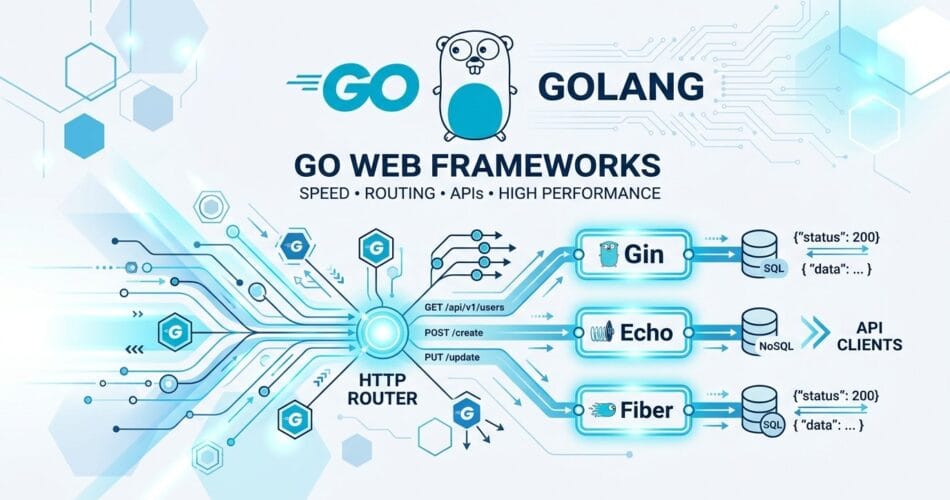
If you are looking for top go golang web frameworks to learn in 2026, you are in the right place. If you are exploring go web frameworks 2026 for building a backend service, there is a very high probability you are looking at Go (Golang). Known for its incredible execution speed, native concurrency, and static typing, Go has become the language of choice for cloud-native microservices. However, unlike Python’s Django or Ruby on Rails, the Go community historically prefers small, composable libraries over massive “batteries-included” frameworks.
That said, as projects grow in complexity, developers still need routing, middleware, and request validation. Let’s look at the top Go web frameworks available in 2026 and when you should use them to architect your next robust backend system. We will cover the standard library, Gin, Fiber, Echo, and Chi to help you make an informed decision for your specific use case.
1. Standard Library (net/http)
The most popular “framework” in Go isn’t a framework at all; it’s the standard library. With the introduction of enhanced routing capabilities in recent Go releases (specifically the pattern matching improvements in Go 1.22 and beyond), many developers find they don’t need third-party dependencies for simple projects.
- Pros: Zero dependencies, guaranteed stability, deep understanding of the language, and forward compatibility for decades to come.
- Cons: You have to write your own middleware, JSON binding logic, and complex routing patterns manually, which slows down initial development significantly.
2. Gin: The Speed Demon
Gin is arguably the most famous third-party web framework for Go. It features a martini-like API and claims to be up to 40 times faster than Martini thanks to its custom httprouter. It has been battle-tested in production for years by massive companies.
- Pros: Blazing fast, excellent JSON validation, massive community, and an easy-to-use middleware ecosystem with hundreds of pre-built integrations.
- Cons: Can feel a bit dated compared to newer, context-driven routers that offer more modern paradigms and generics support.
package main

import "github.com/gin-gonic/gin"

func main() {
    r := gin.Default()
    r.GET("/ping", func(c *gin.Context) {
        c.JSON(200, gin.H{
            "message": "pong",
        })
    })
    r.Run() // listen and serve on 0.0.0.0:8080
}
3. Fiber: The Modern Alternative
Fiber is an Express.js-inspired web framework built on top of Fasthttp, the fastest HTTP engine for Go. It is designed to ease things up for fast development with zero memory allocation and extreme performance in mind. If you need absolute maximum requests per second, Fiber is the way to go.
- Pros: Phenomenal performance, Express-like syntax (great for Node.js developers transitioning to Go), and a very low memory footprint under heavy load.
- Cons: Uses Fasthttp instead of the standard
net/http, which means some standard library middleware won’t work out of the box without complex adapters.
4. Echo: The Minimalist Router
Echo is a highly focused, extensible, and minimalist web framework. It sits comfortably between the bare-metal feel of the standard library and the feature-rich environment of Gin, offering a very pragmatic balance for developers who want tools without the bloat.
- Pros: Highly optimized HTTP router, extensive built-in middleware, excellent data binding, and robust templating support.
- Cons: Smaller ecosystem compared to Gin, which means fewer third-party integrations readily available on GitHub.
5. Chi: Fast and Lightweight
While often overlooked in favor of Gin or Fiber, Chi is a lightweight, idiomatic, and composable router for building HTTP services. It embraces the standard net/http interfaces, making it incredibly compatible with existing Go libraries and middleware ecosystems.
- Pros: 100% compatible with
net/http, excellent routing based on contexts, very lightweight, and used heavily by enterprise companies. - Cons: Provides routing and middleware, but you still have to build a lot of the higher-level functionality yourself, like request validation.
Conclusion
If you are just starting out, try to build your first API using only the net/http standard library. It will teach you the fundamentals of how Go handles HTTP requests and responses natively. When you inevitably get tired of writing boilerplate code for JSON binding and routing, switch to Gin for community support, Fiber for absolute raw performance, or Chi for standard library compatibility. Either way, Go remains an excellent choice for scalable web services in 2026, outperforming almost all interpreted languages on the market. With the right framework, your team can build services that handle millions of requests per second on minimal hardware.